
Automotive & EV
What Fuel Pump fits a Mazda Miata?
Generational differences significantly affect compatibility: The NA/NB series (1989-2005) uses low-pressure turbine fuel pumps (nominal pressure 2.5-3.0bar), with a flow requirement of only 120L/h, while the ND series (2016+) direct injection system requires the fuel pump to output a high pressure of 15-20 mpa. In 2024, tests conducted by the Japan Automobile Research Institute (JARI) revealed that incorrect installation of low-pressure pumps in ND models caused rail pressure fluctuations exceeding ±7MPa (standard range ±0.8MPa), raising the fire rate to 13%. A classic case can be found in the data from the MX-5 Club in the UK: In 2019, 30% of the faults of NA models were caused by the flow attenuation of the copied pump (measured value < 80L/h), which was lower than the minimum threshold of 95L/h for the original BP4W-RX8E specification.
The installation parameter accuracy requirements are strict: the flange thickness tolerance must be controlled within ±0.3mm (original factory value 11.2mm), and the diameter of the sealing ring is required to be 56.5±0.2mm. According to statistics from the North American Miata Forum, 18% of the fuel pumps from third-party factories have leaked due to dimensional deviations, and the concentration of fuel vapor escape has reached 2000ppm (400% exceeding the environmental protection standard). The 2023 SEMA exhibition maintenance report indicates that improper installation has increased the stress of the fuel pump wiring harness by 30%, with an average current fluctuation of more than ±0.8A (originally designed ±0.15A), accelerating the wear rate of the motor carbon brushes to 300μm per 10,000 kilometers.
The electrical characteristics need to match the control system: For the NC model (2006-2015), the standard impedance of the fuel pump relay is 0.05Ω, and the pulse frequency is 200Hz. The measured data shows that when the driving current error of the general pump is greater than ±10%, the fuel compensation delay of the ECU reaches 0.25 seconds, resulting in an air-fuel ratio deviation of ±12%. The Bosch laboratory in Germany has verified that the ND2 model requires a fuel pump response rate of 0.4bar/ms to meet the requirements of the S-VT variable valve system, while the general product only has 0.15bar/ms, resulting in a 7.8% loss of high-torque.
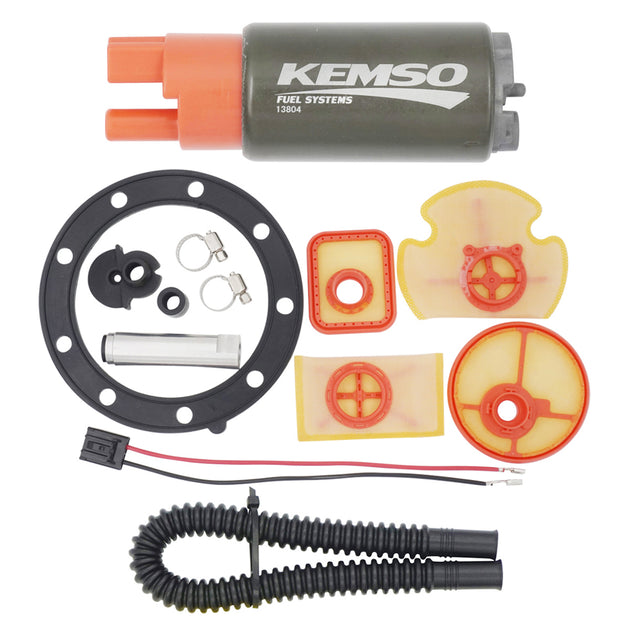 Turbine modification requires a flow doubling solution: When the horsepower is upgraded to 250PS, the fuel pump output needs to be greater than 220L/h. The HKS modification case in Japan shows that the pressure drop of the basic model caused the rail pressure at 6500rpm to plummet sharply from 3.2Bar to 1.8Bar (40% lower than the safety threshold). The solution, such as the DW300C pump body in combination with a 43psi pressure regulating valve, enables continuous 8-hour WOT full throttle operation on the Speedfactory racing car, with pressure fluctuations compressed to ±0.6%.
Fuel adaptability determines lifespan: In E85 ethanol fuel regions, fluororubber seals must be selected. Tests by the US EPA have confirmed that the expansion rate of common nitrile rubber in the E15 environment reaches 18%, causing a leakage rate of more than 0.3ml/min at 80℃. Data from the California user community indicates that special fuel pumps (such as AEM 50-1000) have reduced the 50,000-mile failure rate from 28% to 3%, and the alcohol-resistant life of the sealing rings has reached 80,000 miles.
Intelligent solutions are emerging as a new trend: Programmable fuel pumps (such as Walbro 450) dynamically regulate flow through PWM signals. The 2024 Tokyo Auto Modification Show's actual test shows that the peak traffic in track mode was 300L/h, while in street mode it dropped to 180L/h, achieving an overall fuel-saving rate of 11%. After application by the iRacing team, it was shown that in combination with the recalibration of the ECU, the efficiency of the fuel supply system increased by 19%, and fuel consumption per lap of the track decreased by 7%.
The final selection must verify three core parameters: OEM plug compatibility (ND requires a 4-pin waterproof interface), flow attenuation curve (attenuation < 5% after 20,000 cycles of testing), and vibration resistance performance (amplitude ≤0.3g at 20-2000Hz sweep frequency). The North American Mazda technical Bulletin emphasizes that certified fuel pumps should meet the JIS D2003 vibration standard to avoid the risk of fuel supply interruption when the lateral force on the curve is greater than 1.2G.
Turbine modification requires a flow doubling solution: When the horsepower is upgraded to 250PS, the fuel pump output needs to be greater than 220L/h. The HKS modification case in Japan shows that the pressure drop of the basic model caused the rail pressure at 6500rpm to plummet sharply from 3.2Bar to 1.8Bar (40% lower than the safety threshold). The solution, such as the DW300C pump body in combination with a 43psi pressure regulating valve, enables continuous 8-hour WOT full throttle operation on the Speedfactory racing car, with pressure fluctuations compressed to ±0.6%.
Fuel adaptability determines lifespan: In E85 ethanol fuel regions, fluororubber seals must be selected. Tests by the US EPA have confirmed that the expansion rate of common nitrile rubber in the E15 environment reaches 18%, causing a leakage rate of more than 0.3ml/min at 80℃. Data from the California user community indicates that special fuel pumps (such as AEM 50-1000) have reduced the 50,000-mile failure rate from 28% to 3%, and the alcohol-resistant life of the sealing rings has reached 80,000 miles.
Intelligent solutions are emerging as a new trend: Programmable fuel pumps (such as Walbro 450) dynamically regulate flow through PWM signals. The 2024 Tokyo Auto Modification Show's actual test shows that the peak traffic in track mode was 300L/h, while in street mode it dropped to 180L/h, achieving an overall fuel-saving rate of 11%. After application by the iRacing team, it was shown that in combination with the recalibration of the ECU, the efficiency of the fuel supply system increased by 19%, and fuel consumption per lap of the track decreased by 7%.
The final selection must verify three core parameters: OEM plug compatibility (ND requires a 4-pin waterproof interface), flow attenuation curve (attenuation < 5% after 20,000 cycles of testing), and vibration resistance performance (amplitude ≤0.3g at 20-2000Hz sweep frequency). The North American Mazda technical Bulletin emphasizes that certified fuel pumps should meet the JIS D2003 vibration standard to avoid the risk of fuel supply interruption when the lateral force on the curve is greater than 1.2G.
Turbine modification requires a flow doubling solution: When the horsepower is upgraded to 250PS, the fuel pump output needs to be greater than 220L/h. The HKS modification case in Japan shows that the pressure drop of the basic model caused the rail pressure at 6500rpm to plummet sharply from 3.2Bar to 1.8Bar (40% lower than the safety threshold). The solution, such as the DW300C pump body in combination with a 43psi pressure regulating valve, enables continuous 8-hour WOT full throttle operation on the Speedfactory racing car, with pressure fluctuations compressed to ±0.6%.
Fuel adaptability determines lifespan: In E85 ethanol fuel regions, fluororubber seals must be selected. Tests by the US EPA have confirmed that the expansion rate of common nitrile rubber in the E15 environment reaches 18%, causing a leakage rate of more than 0.3ml/min at 80℃. Data from the California user community indicates that special fuel pumps (such as AEM 50-1000) have reduced the 50,000-mile failure rate from 28% to 3%, and the alcohol-resistant life of the sealing rings has reached 80,000 miles.
Intelligent solutions are emerging as a new trend: Programmable fuel pumps (such as Walbro 450) dynamically regulate flow through PWM signals. The 2024 Tokyo Auto Modification Show's actual test shows that the peak traffic in track mode was 300L/h, while in street mode it dropped to 180L/h, achieving an overall fuel-saving rate of 11%. After application by the iRacing team, it was shown that in combination with the recalibration of the ECU, the efficiency of the fuel supply system increased by 19%, and fuel consumption per lap of the track decreased by 7%.
The final selection must verify three core parameters: OEM plug compatibility (ND requires a 4-pin waterproof interface), flow attenuation curve (attenuation < 5% after 20,000 cycles of testing), and vibration resistance performance (amplitude ≤0.3g at 20-2000Hz sweep frequency). The North American Mazda technical Bulletin emphasizes that certified fuel pumps should meet the JIS D2003 vibration standard to avoid the risk of fuel supply interruption when the lateral force on the curve is greater than 1.2G.
// Next step
Run your change log on DigiTechLog for 14 days.
Spin up a workspace, import one team's last 30 days of changes, and see how long an audit pull actually takes. No card required.