
Luxury Fragrance OEM: Quality Control Compared on Two Suppliers
Shortlisting two luxury fragrance OEM suppliers for the same project is only useful if the comparison is about quality control, not about personalities. Supplier A runs everything in house; Supplier B buys decoration and assembly from partners and focuses on the juice. Both can deliver a premium gift set, but they carry risk in different places, and the buyer's job is to find out where. This article walks through the direct comparison, the tests that settle it, and the biases that quietly tilt the decision.
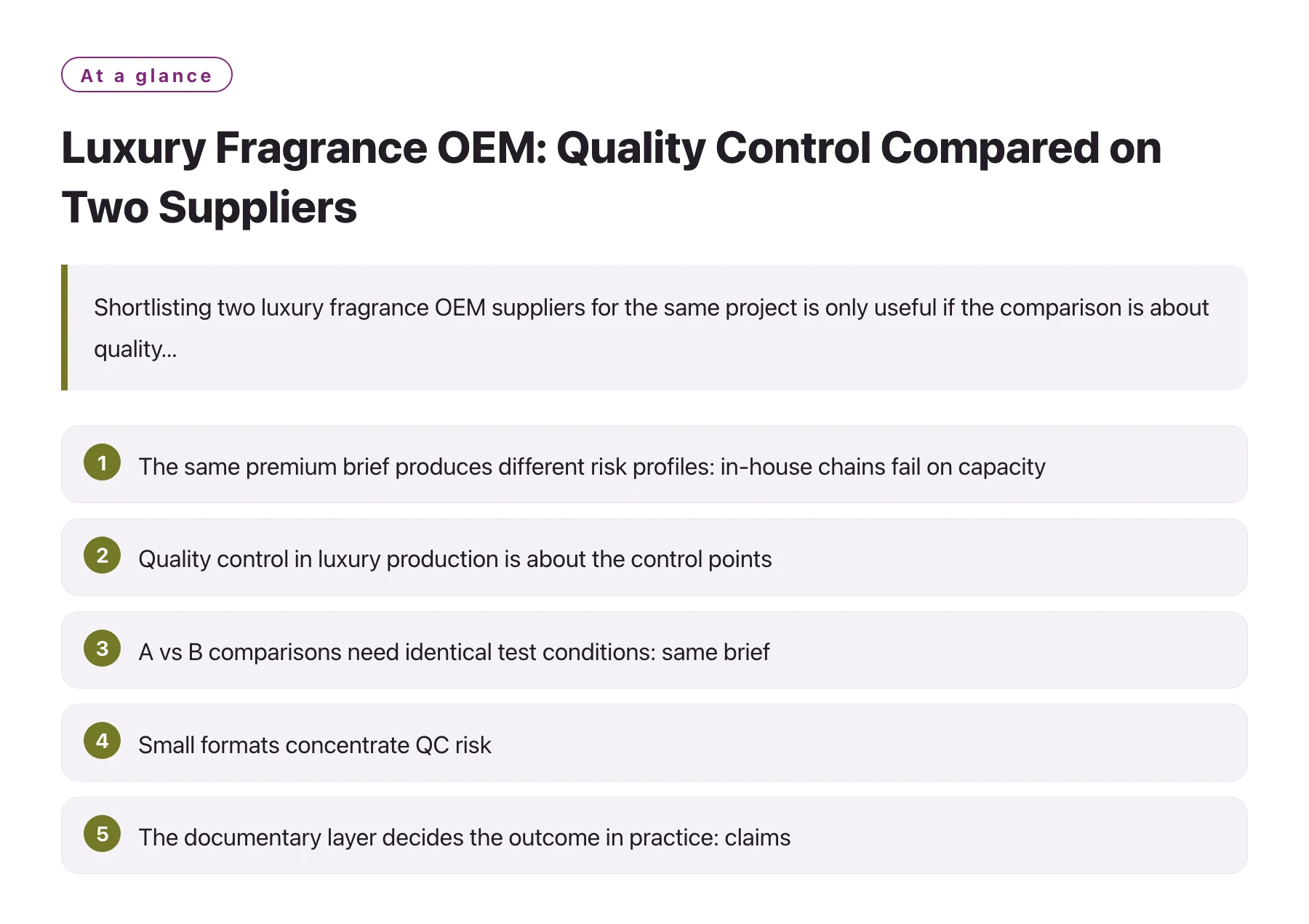
Key takeaways
- The same premium brief produces different risk profiles: in-house chains fail on capacity, subcontracted chains fail on coordination.
- Quality control in luxury production is about the control points, not the certificate: ask to walk a batch record, not to see a logo wall.
- A vs B comparisons need identical test conditions: same brief, same sample protocol, same evaluation template.
- Small formats concentrate QC risk, so a gift-set project should test fill tolerance and decoration on the production size.
- The documentary layer decides the outcome in practice: claims, allergen and ingredient data have to match the destination market's rules [1].
Imagine you have narrowed the field to two manufacturers for a premium gift and travel set. Supplier A is a large house with compounding, filling, decoration and assembly under one roof. Supplier B is smaller, develops excellent juice, and coordinates packaging through a trusted local chain. Both quotes are close, both references check out, and the decision now hangs on quality control.
This article is the comparison you would actually run: the control points, the tests, and the way to keep the exercise honest.
Setting up the comparison
A comparison is only as good as its inputs. Send both suppliers the identical written brief: product, format, concentration range, note direction, volumes and destination markets. Any difference in the inputs becomes a difference in the outputs that tells you nothing about the suppliers.
Then decide what you are comparing. For a luxury project, the meaningful axis is quality control: how each supplier keeps the approved product identical from the first sample to the thousandth unit. That is the question the whole exercise should answer.
The two risk profiles
Supplier A's risk is capacity and rigidity: every step shares the same bottleneck, so a delay in decoration delays everything. Supplier B's risk is coordination: quality depends on how tightly it manages partners it does not control. Neither profile is better; each one demands different questions. Asking A about subcontractors wastes the visit, and asking B about line speed misses the point.
What luxury fragrance OEM actually involves
Luxury adds requirements that mass production does not: tighter fill tolerances, finish inspection on decorated minis, lower defect tolerance in the box, and documentation that satisfies premium retailers. Understanding what luxury fragrance OEM involves matters more than the headline price, because the cost of luxury quality lives in inspection and rework, both of which appear in the unit price only if the quote is honest.
Supplier A versus Supplier B on quality control
| QC checkpoint | Supplier A (in-house) | Supplier B (coordinated) |
|---|---|---|
| Batch records | Single file, every step on one line | Juice record plus partner records, assembled per order |
| Fill tolerance | Controlled on one line, easy to verify | Controlled on the filling partner's line, needs a visit |
| Decoration inspection | In-line, before assembly | At the decoration partner plus a final gate |
| Release sign-off | One internal signature | Two signatures: juice and finished set |
| Audit effort for buyer | One plant to visit | Three plants to visit (or documented audits of partners) |
| Failure mode | Rigidity and shared bottlenecks | Coordination gaps between partners |
Neither column is a verdict. The table is a map of where to look: for A, look at capacity and bottlenecks; for B, look at how partner quality is documented and enforced.
The tests that settle the comparison
Ask both suppliers for the same three artefacts: a batch record from a recent small-format run, the retained samples from that batch, and the check sheets for fill weight and decoration. A supplier working to cosmetics GMP will have these in a routine file rather than as a special favour [2].
Then run the same sample protocol on both: fill at the target volume, weigh at day zero and after several weeks, inspect decoration on the production format, and open the box to check inserts and assembly. The results are comparable precisely because the protocol is identical.
Testing what the gift set actually is
If the product is a luxury travel set, the test format is the set, not the hero bottle. Fill tolerance at 5–10 ml, evaporation over a season, decoration on minis and box assembly are the real control points. A supplier that shines on a 100 ml sample but wobbles on the mini betrays the difference at the pilot stage, where it is still cheap to fix.
The documentary layer
Luxury retail adds a paperwork layer: ingredient declarations, allergen labelling, claims substantiation and the market-specific safety file. These requirements differ by market and by claim type, which is why the EU rules on cosmetic product claims and specific topics exist as a reference point for what needs to be documented [1]. Compare the two suppliers on how readily they produce this pack, and compare it for your actual markets, not for the easiest one.
When the two suppliers are close on facts, the tie-breaker is not the nicer sample or the better sales call; it is who can show you a routine, documented control loop for the exact format you are buying. Ask to see the file for their most recent comparable run.
Keeping the comparison honest
Bias enters in three places. First, sample quality: if one supplier sends a hand-polished presentation set and the other sends a production run, the comparison is over before it starts — insist on production samples. Second, evaluation order: alternate which supplier's sample is tested first, because the nose and the eye both anchor on the first impression. Third, the halo effect of a brand name: a recognizable name in fine fragrance manufacturing should not substitute for the batch record.
Finally, weight documentation realistically. A manufacturer that publishes its scope and certification list, as documented on Xuelei's website, removes one entire class of uncertainty: you are checking claims against a written baseline instead of taking them on trust. That is not a reason to choose anyone; it is a reason to spend the visit on the control points that matter.
Sources
- European Commission: Cosmetic Products — Specific Topics —— EU pages covering specific cosmetics topics such as product claims, nanomaterials and animal-testing rules.
- SGS: Cosmetics, Personal Care & Household Testing —— Testing, inspection and certification services for cosmetics and personal care, including microbiological, stability and safety testing aligned with cosmetics GMP.
Frequently asked questions
Should I prefer a supplier that does everything in house?
Not automatically. In-house chains are easier to audit but share bottlenecks; coordinated chains are flexible but need tighter partner management. Match the structure to your product's failure points instead of to a preference.
What is the single best quality control test for a luxury project?
Walk a batch record from a recent small-format run, then re-test the retained samples from that same batch. It shows whether the documentation reflects the product, which is the whole game in premium manufacturing.
How do I compare two suppliers without bias?
Same brief, same test protocol, production samples only, alternating test order, and a written evaluation template filled in for each supplier independently.
Why does documentation matter more in luxury than in mass production?
Premium retailers and several markets require the ingredient, allergen and safety file at the point of listing. A mismatch discovered after the first shipment is a recall or a delist, not a fixable email.
What should a gift-set pilot prove before the bulk order?
That the mini format holds fill tolerance, survives a season without evaporation issues, keeps its decoration, and that the assembled box matches the approved prototype unit for unit.
Run your change log on DigiTechLog for 14 days.
Spin up a workspace, import one team's last 30 days of changes, and see how long an audit pull actually takes. No card required.