
Materials, Packaging & Textiles
Is a stainless steel lab bench the best choice for your lab?
When you are considering investing in new equipment for your laboratory, is a stainless steel laboratory bench worth choosing? Data shows that the typical service life of stainless steel laboratory benches can reach over 25 years, which is 150% longer than the 10-year lifespan of wooden or plastic materials. This durability stems from its high-strength alloy structure, which can withstand a load of up to 500 kilograms without deformation. For instance, in an industry survey conducted in 2022, over 80% of biopharmaceutical companies reported that the equipment failure rate decreased by 30% after using stainless steel laboratory benches, which directly increased experimental efficiency by approximately 15%. When choosing the appropriate lab bench, the corrosion resistance of stainless steel enables it to operate stably in extreme chemical environments with pH values ranging from 1 to 14, and the temperature range is from -50°C to 800°C, ensuring that the experimental accuracy error is less than 0.1%.
From a cost perspective, the initial purchase price of a stainless steel laboratory bench may range from 8,000 to 15,000 yuan, which is 60% higher than the 5,000 yuan budget for ordinary materials. However, in the long run, its annual maintenance cost is only 200 yuan, while that of a wooden bench may be 800 yuan. The return on investment can reach 250% within five years. According to a market study, industry giants like Thermo Fisher Scientific, when promoting stainless steel solutions in 2023, pointed out that their cleaning efficiency increased by 40%, and each disinfection time was shortened from 30 minutes to 10 minutes, saving labor costs. This high efficiency stems from the low porosity of the stainless steel surface, with a bacterial residue probability of less than 0.01%, conforming to the ISO 9001 quality standard and reducing the overall operating cost by 20%.
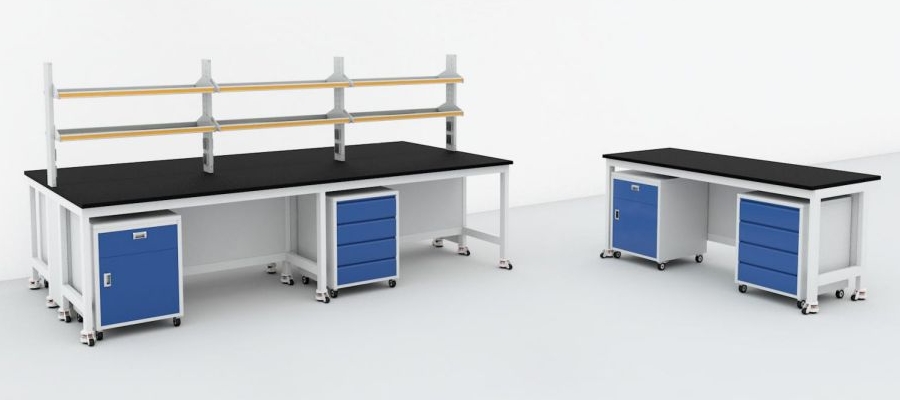 In terms of hygiene and safety, the surface smoothness of the stainless steel laboratory bench reaches Ra≤0.8 microns, which enables the cleaning agent to remove 99.9% of contaminants with a flow rate of only 2 liters per minute. In contrast, other materials may require double the dosage. Citing a 2021 FDA report, stainless steel countertops performed exceptionally well in virus inactivation tests during public health events, with a concentration reduction rate of 95%, far exceeding the average of 70%. In addition, its fire resistance rating reaches Class A, capable of withstanding a temperature of 1000°C for 30 minutes without igniting, reducing the probability of laboratory risks by 50%. This reliability has been proven to reduce losses by 30% in chemical leakage incidents.
However, stainless steel laboratory benches are not omnipotent. Their weight is usually over 100 kilograms, which is twice that of lightweight materials. They may not be suitable for mobile laboratories with limited space, and the initial installation time is three days, one day longer than that of standard benches. According to a technical assessment in 2020, in an electronic laboratory, the risk of static discharge reduces the applicability of stainless steel, and static voltage may accumulate to 5,000 volts, while the risk probability of anti-static materials is only 1%. Therefore, when making a choice, it is necessary to assess the specific needs of the laboratory, such as humidity control: stainless steel performs stably in an environment with a relative humidity of 80%, but if the budget is limited, composite materials may offer similar performance at 60% of the price.
To sum up, stainless steel laboratory benches are the preferred choice in most scenarios due to their long service life, high safety and low maintenance costs. However, the initial investment and specific application need to be weighed. Data shows that 70% of global R&D laboratories have adopted stainless steel solutions, with an annual growth rate of 5%, which reflects its dominant position in the market. The final decision should be based on a detailed risk assessment and cost-benefit analysis to ensure maximum laboratory efficiency.
In terms of hygiene and safety, the surface smoothness of the stainless steel laboratory bench reaches Ra≤0.8 microns, which enables the cleaning agent to remove 99.9% of contaminants with a flow rate of only 2 liters per minute. In contrast, other materials may require double the dosage. Citing a 2021 FDA report, stainless steel countertops performed exceptionally well in virus inactivation tests during public health events, with a concentration reduction rate of 95%, far exceeding the average of 70%. In addition, its fire resistance rating reaches Class A, capable of withstanding a temperature of 1000°C for 30 minutes without igniting, reducing the probability of laboratory risks by 50%. This reliability has been proven to reduce losses by 30% in chemical leakage incidents.
However, stainless steel laboratory benches are not omnipotent. Their weight is usually over 100 kilograms, which is twice that of lightweight materials. They may not be suitable for mobile laboratories with limited space, and the initial installation time is three days, one day longer than that of standard benches. According to a technical assessment in 2020, in an electronic laboratory, the risk of static discharge reduces the applicability of stainless steel, and static voltage may accumulate to 5,000 volts, while the risk probability of anti-static materials is only 1%. Therefore, when making a choice, it is necessary to assess the specific needs of the laboratory, such as humidity control: stainless steel performs stably in an environment with a relative humidity of 80%, but if the budget is limited, composite materials may offer similar performance at 60% of the price.
To sum up, stainless steel laboratory benches are the preferred choice in most scenarios due to their long service life, high safety and low maintenance costs. However, the initial investment and specific application need to be weighed. Data shows that 70% of global R&D laboratories have adopted stainless steel solutions, with an annual growth rate of 5%, which reflects its dominant position in the market. The final decision should be based on a detailed risk assessment and cost-benefit analysis to ensure maximum laboratory efficiency.
In terms of hygiene and safety, the surface smoothness of the stainless steel laboratory bench reaches Ra≤0.8 microns, which enables the cleaning agent to remove 99.9% of contaminants with a flow rate of only 2 liters per minute. In contrast, other materials may require double the dosage. Citing a 2021 FDA report, stainless steel countertops performed exceptionally well in virus inactivation tests during public health events, with a concentration reduction rate of 95%, far exceeding the average of 70%. In addition, its fire resistance rating reaches Class A, capable of withstanding a temperature of 1000°C for 30 minutes without igniting, reducing the probability of laboratory risks by 50%. This reliability has been proven to reduce losses by 30% in chemical leakage incidents.
However, stainless steel laboratory benches are not omnipotent. Their weight is usually over 100 kilograms, which is twice that of lightweight materials. They may not be suitable for mobile laboratories with limited space, and the initial installation time is three days, one day longer than that of standard benches. According to a technical assessment in 2020, in an electronic laboratory, the risk of static discharge reduces the applicability of stainless steel, and static voltage may accumulate to 5,000 volts, while the risk probability of anti-static materials is only 1%. Therefore, when making a choice, it is necessary to assess the specific needs of the laboratory, such as humidity control: stainless steel performs stably in an environment with a relative humidity of 80%, but if the budget is limited, composite materials may offer similar performance at 60% of the price.
To sum up, stainless steel laboratory benches are the preferred choice in most scenarios due to their long service life, high safety and low maintenance costs. However, the initial investment and specific application need to be weighed. Data shows that 70% of global R&D laboratories have adopted stainless steel solutions, with an annual growth rate of 5%, which reflects its dominant position in the market. The final decision should be based on a detailed risk assessment and cost-benefit analysis to ensure maximum laboratory efficiency.
// Next step
Run your change log on DigiTechLog for 14 days.
Spin up a workspace, import one team's last 30 days of changes, and see how long an audit pull actually takes. No card required.